Visiting CAS

Trial Visits
If you are unsure about joining, you are welcome to attend a maximum of 2 monthly meetings as a visitor to see what you think of the Society. There is a small charge of £2 per person per visit, but if you join the Society during the evening of your visit the charge for that evening will be fully refunded. If you wish to continue beyond those 2 visits we will require you to become a member.

Our monthly meetings take place at Deer Park Archers, Shurdington.
See the map below or use the What Three Words app to obtain a precise location, using “shudders.stewing.genetics”. what3words.com/shudders.stewing.genetics

The turning off the A46 is rather hidden. Looking rather like a lay-by here is a photo:


Visitors are welcome!

CAS Sky Notes for February 2026

CAS Sky Notes for February 2026

Winter continues and the nights are long and dark.  If we manage some clear skies, then this is a good time of year for observing. 

Planets

Mercury

Mercury becomes an evening object, reaching greatest eastern elongation on the 19th of the month, reaching 18o east of the Sun.  It should be a good target to look for this month.

Venus

Venus becomes an evening object, but is still rather too close to the Sun to be easily observable this month.

Mars

Mars reached conjunction in January and is not observable this month, or for quite a few months yet.

Jupiter

Jupiter is just past opposition and is therefore observable throughout the night.  It is a very prominent object in Gemini, just below the twin stars of Castor and Pollux. It is very well placed for observing and gets very high in the sky, meaning it avoids a lot of the atmospheric turbulence lower down. I recommend the website https://shallowsky.com/jupiter which shows you the position of the Galilean moons and the Great Red Spot at any time you pick. 

Saturn

Saturn is becoming much harder to observe as it sinks into the west.  It sets by 8pm by the middle of the month.  The rings are still nearly edge on, but will just be visible if you get a chance to view them before Saturn is lost in the twilight.

Uranus

Uranus remains visible throughout this month.  It lies in Taurus, a little below the Pleiades.  Its coordinates: RA 03h 43m , Dec +19.5o, and magnitude +5.7.

Neptune

Neptune is becoming harder to observe, as it is close to Saturn, being a little above it.  It sets by mid evening.

Moon Phases:

1st Feb:  Full Moon  9th Feb:   Last Quarter
17th Feb:  New Moon 24th Feb:   First Quarter

 Sun

The Sun remains low in the sky at this time of year, but still fairly active as it is still near solar maximum, so do watch out for large Sunspot groups.  Remember to never look at the Sun directly without a proper solar filter.

Aurora

Aurora may be visible this month as the northern skies are dark early.  Watch out for any exceptional activity though, using one of the many aurora alert apps.

 Meteors

There are no notable meteor showers this month.

Deep Sky Objects

The Orion Nebula is well placed, as well as the Pleiades. To the east of Gemini (where Jupiter is) lies the sickle of Leo.  Between these is Cancer.  Look for the beautiful open cluster Praesepe M44, which is a lovely open cluster and a good target for astrophotography. I captured this inadvertently while photographing the aurora in northern Finland in December.

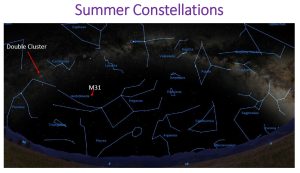
The Andromeda galaxy (M31) remains well placed, being almost overhead by mid evening.  This also applies to the Double Cluster in Perseus.  Both make great objects in binoculars or a small telescope and fantastic objects for astrophotography.

Neil Havard.

Any questions or for more information, contact Neil at coordassist@cotswoldas.org.uk

To download this post as a PDF click HERE


CAS Sky Notes for January 2026

Winter is well and truly upon us and the nights are long and dark.  If we manage some clear skies, then this is a good time of year for observing.

There are some interesting this to look out for this month

Planets

Mercury

Mercury reaches superior conjunction on 21st January.  It remains close to the Sun and is not really observable this month.

Venus

Venus reaches superior conjunction on the 6th January and is not observable this month

Mars

Mars finally reaches conjunction on the 9th January and is not observable this month, or for quite a few months yet.

Jupiter

Jupiter reaches opposition on the 10th January and is therefore observable throughout the night.  It is a very prominent object in Gemini, just below the twin stars of Castor and Pollux. It is very well placed for observing and gets very high in the sky, meaning it avoids a lot of the atmospheric turbulence lower down. I recommend the website https://shallowsky.com/jupiter which shows you the position of the Galilean moons and the Great Red Spot at any time you pick.  A few transits are as follows:

On the 6th, at 01.56UT, Io will transit Jupiter.  As Jupiter is close to opposition, the Moon and its shadow will appear close together.  It does this again on the 7th at 02:20UT. Ganymede transits on the 7th at 02:06UT and the shadow and moon are touching.  If you’re up and it’s clear, this could be worth looking for.  On the 10th at 07:11UT (opposition day) Calisto starts to transit in front of its shadow.

Saturn

Saturn is past its best now and will soon be moving into the twilight.  Its magnitude is at +1 throughout the month, but the rings remain very nearly edge on throughout the month.  Although still fairly low in the sky, it can be found in Aquarius, below the square of Pegasus. By mid-month, its coordinates are: RA 23h 49m, Dec -3o 34’.  Note: As it’s a planet, it won’t twinkle like a star, making it easier to identify.  You can use https://shallowsky.com to access the moons of Saturn as well.

Uranus

Uranus remains visible throughout this month.  It lies in Taurus, a little below the Pleiades.  Its coordinates: RA 03h 43m, Dec +19.5o, and magnitude +5.7.

Neptune

Neptune is still observable, as it is close to Saturn, being a little above it.  It is not an easy object, but it can be found with coordinates:  RA 0h 00m 21s, Dec -1o 25’.  It is also below the square of Pegasus and has a magnitude of +7.9.  By the end of the month it will become a more difficult object.

Moon Phases: 

3rd Jan:  Full Moon 10th Jan:   Last Quarter
18th Jan:  New Moon 26th Jan:   First Quarter

The Lunar X and Lunar V shapes may be seen around 17.00UT on the 25th January.  These shapes appear on the terminator, due to light catching crater rims, and are worth looking for.  The X is south of the equator and the V to the north.

Occultations: On the evening of the 27th January from about 21:30UT, the gibbous Moon passes through the northern part of the Pleiades, occulting several stars.  This could be a job for video.

Sun

The Sun is very low in the sky at this time of year, but still fairly active as it is still near solar maximum, so do watch out for large Sunspot groups.  Remember to never look at the Sun directly without a proper solar filter.

Earth reaches perihelion around the 4th January and so is at its closest to the Sun.  It won’t feel particularly warm though!

Aurora

Aurora may be visible this month as the northern skies are dark early.  Watch out for any exceptional activity though, using one of the many aurora alert apps.

 Meteors

The Quadrantid meteor shower occurs around the 3rd January. The Zenithal Hourly Rate (ZHR) at maximum may reach 80, but this year’s display will be rather spoiled by the full Moon. They are one of the richest showers of the year and well worth looking out for.  There are many slow and bright meteors to be seen. As we will be approaching new Moon, these could be very favourable.

Deep Sky Objects

The Orion Nebula is well placed, as well as the Pleiades. To the east of Gemini (where Jupiter is) lies the sickle of Leo.  Between these is Cancer.  Look for the beautiful open cluster Praesepe M44, which is a lovely open cluster and a good target for astrophotography.

The Andromeda galaxy (M31) is very well placed, being almost overhead by mid evening.  This also applies to the Double Cluster in Perseus.  Both make great objects in binoculars or a small telescope and fantastic objects for astrophotography.

Neil Havard.

Any questions or for more information, contact Neil at coordassist@cotswoldas.org.uk

To download this post as a PDF click HERE

CAS Sky Notes for December 2025

The winter nights are here. The winter constellations, like Gemini, Taurus and Orion are becoming observable throughout most of the night. 

Planets

Mercury

Mercury passed through inferior conjunction in late November and becomes a morning object.  It reaches greatest western elongation on the 8th December and will be 20.7o from the Sun.  The low declination may make it a tricky object, but it will be quite bright at magnitude -0.5 then. 

Venus

Venus is not really observable this month as it approaches conjunction with the Sun.  It will pass through superior conjunction next year.

Mars

Mars is technically still an evening object but is lost in the twilight.

Jupiter

Jupiter is becoming an evening object, it rises by 7.30pm in the middle of the month. It is a prominent object in Gemini, just below the twin stars of Castor and Pollux and is approaching opposition early in January. I recommend the website https://shallowsky.com/jupiter which shows you the position of the Galilean moons and the Great Red Spot at any time you pick.

Saturn

Saturn is well past opposition and is still visible throughout the night.  Its magnitude is at +1 throughout the month, but the rings are very nearly edge on throughout the month.  Although still fairly low in the sky, it can be found below the square of Pegasus. By mid month, its coordinates are: RA 23hr 46m, Dec -4o.  note: As it’s a planet, it won’t twinkle like a star, making it easier to identify.  You can use https://shallowsky.com to access the moons of Saturn as well.

Uranus

Uranus reached opposition on November 21st,and is therefore well placed for observation throughout the night.  It lies in Taurus with coordinates: RA 03h 46m , Dec +19.5o, between the Pleiades and Aldebaran.

Neptune

Neptune has just passed opposition on 23rd September and is also observable throughout the night.  It is not an easy object, but it can be found with coordinates:  RA 23h 59m, Dec -1.5o.  It is also below the square of Pegasus and not far from Saturn. 

Moon Phases:

 4th Dec:  Full Moon                                         11th Dec:   Last Quarter

20th Dec:  New Moon                                      27th Dec:   First Quarter

Lunar Occultation:  On 12th December, between 07h 27m and 08h 28m the Moon will occult Regulus. It disappears on the bright side and this may just be observable around dawn.

 Sun

The Sun is low in the sky at this time of year, but still fairly active as it is still near solar maximum, so do watch out for large Sunspot groups.  Remember to never look at the Sun directly without a proper solar filter.

Aurora

Aurora may be easier to see this month as the northern skies get dark quite early.  Watch out for any exceptional activity though, using one of the many aurora alert apps.

 Meteors

The Geminids occur between the 4th and 17th December, with the peak on the evening of the 14th.  The Zenithal Hourly Rate (ZHR) at maximum may exceed 100. They are one of the richest showers of the year and well worth looking out for.  There are many slow and bright meteors to be seen. As we will be approaching new Moon, these could be very favourable.

Deep Sky Objects

The Milky Way is still well placed, passing nearly overhead.  Be sure to go to as dark a site as possible if you wish to see it.  Somewhere in the countryside around Guiting Power or Miserden may be the best,  You can take a photo using a smart phone such as the iPhone 16.  It needs to be on a tripod (or propped against something).  Using night mode, you can take a 30 second single exposure. Using the Astroshader App makes the task better as it will stack in camera.

The Orion Nebula is becoming well placed, as well as the Pleiades.

The Andromeda galaxy (M31) is very well placed, being almost overhead by mid evening.  This also applies to the Double Cluster in Perseus.  Both make great objects in binoculars or a small telescope and fantastic objects for astrophotography.

Neil Havard.

Any questions or for more information, contact Neil at coordassist@cotswoldas.org.uk

To view this in PDF format please CLICK HERE

CAS Sky Notes for November 2025

The clocks have now gone back and so the nights are dark from early in the evening. The summer constellations, like Cygnus, Lyra, and Hercules are dropping into the western skies and the Milky Way is still well placed from a dark site.  The winter constellations such as Orion, are now rising in the late evening by the end of the month.

Planets

Mercury

Mercury was at greatest eastern elongation of 24o on the 29th October and so starts the month as an evening object.  However, its southern declination means it sets to soon after the Sun and is not well placed. It moves in towards the Sun throughout the month, going through inferior conjunction early next month 

Venus

Venus is still a morning object, but is becoming very difficult.  The elongation decreases to only 10o by the end of the month.  The magnitude remains around -3.9, while the phase increases to 99% by the end of the month.  The diameter is only around 10 arcsec.  It will pass through superior conjunction next year.

Mars

Mars is technically still an evening object but is lost in the twilight.

Jupiter

Jupiter is becoming an evening object, it rises by 10 pm at the start of the month and by 8pm at the end of the month. It is a prominent object in Gemini, just below the twin stars of Castor and Pollux and is approaching opposition early in January. I recommend the website https://shallowsky.com/jupiter which shows you the position of the Galilean moons and the Great Red Spot at any time you pick.

Saturn

Saturn is past opposition now and is therefore visible throughout the night.  Its magnitude is at +0.9 throughout the month, but the rings are very nearly edge on throughout the month.  Although still fairly low in the sky, it can be found below the square of Pegasus. By mid month, its coordinates are: RA 23hr 46m, Dec -4o.  note: As it’s a planet, it won’t twinkle like a star, making it easier to identify.  You can use https://shallowsky.com to access the moons of Saturn as well.

Uranus

Uranus reaches opposition on November 21st,and is therefore well placed for observation throughout the night.  It lies in Taurus with coordinates: RA 03h 50m , Dec +20o, between the Pleiades and Aldebaran.

Neptune

Neptune has just passed opposition on 23rd September and is observable throughout the night.  It is not an easy object, but it can be found with coordinates:  RA 00h 01m, Dec -1.5o.  It is also below the square of Pegasus and not far from Saturn. 

Moon Phases:

 5th Nov:  Full Moon                                         12th Nov:   Last Quarter

20th Nov:  New Moon                                     28th Nov:   First Quarter

Note that Perigee (Moon at its closest) occurs on 5th November, so that will be classed as a Super moon.

Sun

The Sun is fairly active as it is still near solar maximum, so do watch out for large Sunspot groups.  Remember to never look at the Sun directly without a proper solar filter.

Aurora

Aurora may be easier to see this month as the northern skies get dark much earlier.  Watch out for any exceptional activity though, using one of the many aurora alert apps.

 Meteors

The Leonids occur between the 6th and 30th November, with the peak on the evening of the 17th.  The Zenithal Hourly Rate (ZHR) at maximum is around 15. They are typically very fast meteors that leave persistent trains.  The radiant is around RA +10hr, Dec +21o.  As we will be approaching new Moon, these could be very favourable.

Deep Sky Objects

The Milky Way is still well placed, passing nearly overhead.  Be sure to go to as dark a site as possible if you wish to see it.  Somewhere in the countryside around Guiting Power or Miserden may be the best,  You can take a photo using a smart phone such as the iPhone 16.  It needs to be on a tripod (or propped against something).  Using night mode, you can take a 30 second single exposure. Using the Astroshader App makes the task better as it will stack in camera.

The Andromeda galaxy (M31) is very well placed, being almost overhead by mid evening.  This also applies to the Double Cluster in Perseus.  Both make great objects in binoculars or a small telescope and fantastic objects for astrophotography.

Neil Havard.

Any questions or for more information, contact Neil at coordassist@cotswoldas.org.uk

To view this article in PDF form, please CLICK HERE 


CAS Sky Notes for October 2025

We have now passed the autumnal equinox, giving greater opportunities for observing.  The summer constellations, like Cygnus, Lyra, and Hercules are still high in the sky and the Milky Way runs overhead when seen from a dark site.  Try to escape the city lights if you want the best view though.

 Planets

Mercury

Mercury is not well placed this month.  It is technically an evening object and reaches greatest eastern elongation of 24o on the 29th.  However, its southern declination means it sets to soon after the Sun.

Venus

Venus is still a morning object, but the elongation decreases to 17o by the end of the month.  The magnitude remains around -3.9, while the phase increases to 97% by the end of the month.  The diameter is only around 11 arcsec.  It will pass through superior conjunction next year.

Mars

Mars is technically still an evening object but is lost in the twilight.

Jupiter

Jupiter is still a morning object, but rises around 10 pm by the end of the month when the clocks have gone back. It is a prominent object in Gemini, just below the twin stars of Castor and Pollux.

Saturn

Saturn has just passed opposition and is therefore visible throughout the night.  Its magnitude remains at +0.6, but the rings remain nearly edge on throughout the month.  Although still fairly low in the sky, it can be found below the square of Pegasus. By mid month, its coordinates are: RA 0hr, Dec -2.5o.  note: As it’s a planet, it won’t twinkle like a star, making it easier to identify. 

Uranus

Uranus is approaching opposition next month, but rises by about 6 pm by the end of the month, when the clocks have gone back.  It lies in Taurus with coordinates: RA 03h 54m , Dec +20.1o, between the Pleiades and Aldebaran.

Neptune

Neptune has just passed opposition on 23rd September and is observable throughout the night.  It is not an easy object, but it can be found with coordinates:  RA 00h 03m, Dec -1.5o.  It is also below the square of Pegasus. 

Moon Phases:

 7th Oct:  Full Moon                                          13th Oct:   Last Quarter

21st Oct:  New Moon                                      29th Oct:   First Quarter


Sun

The Sun is fairly active as it is still near solar maximum, so do watch out for large Sunspot groups.  Remember to never look at the Sun directly without a proper solar filter.

Aurora

Aurora may be easier to see this month as the northern skies get darker earlier.  Watch out for any exceptional activity though, using one of the many aurora alert apps.

 Meteors

There Orionid meteor shower reaches its peak around the 20th October, but the maximum is broad, with some meteors being visible throughout the month.  The Zenithal Hourly Rate (ZHR) is at least 20 and in some years it has exceeded this.  This a favourable shower and worth looking for.  The radiant is near Betelgeuse.  These, like many showers, are best observed after midnight.

Deep Sky Objects

The Milky Way is still well placed, passing nearly overhead at the start of the month.  Be sure to go to as dark a site as possible if you wish to see it.  Somewhere in the countryside around Guiting Power or Miserden may be the best,  You can take a photo using a smart phone such as the iPhone 16.  It needs to be on a tripod (or propped against something).  Using night mode, you can take a 30 second single exposure. Using the Astroshader App makes the task better as it will stack in camera.

The Andromeda galaxy (M31) is well placed by late evening.

M51 (Whirlpool) and M101 (Pinwheel) near Ursa Major are also well placed for observation and photography.  M13 and M92 globular clusters in Hercules make good targets. The Ring nebula (M57) in Lyra is another good target, being very high in the sky.  While in that region, have a look at Alberio in Cygnus.  It’s a beautiful double star (orange and blue) and is an easy object to see and view in a small telescope.  The Double cluster in Perseus is another object to view, either in a small telescope or with binoculars in the late evening.

Neil Havard.

Any questions or for more information, contact Neil at coordassist@cotswoldas.org.uk


To view this article in PDF form, please CLICK HERE


CAS Sky Notes for September 2025

The nights are drawing in fast as we approach the autumnal equinox, giving greater opportunities for observing.  The summer constellations, like Cygnus, Lyra, and Hercules are high in the sky and the Milky Way runs overhead when seen from a dark site.  Try to escape the city lights if you want the best view though.

 Planets

Mercury

Mercury will not really be visible this month.  At the start it is still a morning object, but close to the Sun.  It passes through superior conjunction (behind the Sun) on the 13th and into the evening sky.  However, it remains too close to the Sun to observe.

Venus

Venus is still a prominent morning object, but the elongation decreases from 30o to 25o by the end of the month.  The magnitude remains around -3.9, while the phase increases from 86% to 90% by the end of the month.  The diameter is only around 11 arcsec.

Mars

Mars is technically still an evening object but is lost in the twilight.

Jupiter

Jupiter is still a morning object, but rises around midnight by the end of the month. It is a prominent object in the morning sky and is worth getting up to see – honest it really is!

Saturn

Saturn reaches opposition on the 21st and is therefore visible throughout the night.  Its magnitude increases to +0.6, but the rings remain nearly edge on throughout the month.  Although still fairly low in the sky, it can be found below the square of Pegasus. By mid month, its coordinates are: RA 0hr, Dec -2.5o.  Note: As it’s a planet, it won’t twinkle like a star, making it easier to identify.  Also, Titan will be at its furthest point from Saturn (about 150 arcsec) and is easily seen.

Uranus

Uranus is still a morning object, but rises by 10 pm by the end of the month.  It lies in Taurus with coordinates: RA 03h 56m, Dec +20.2o, between the Pleiades and Aldebaran. By the end of the month it should be high enough to observe by midnight.

Neptune

Neptune is in Pisces and reaches opposition on 23rd September and is observable throughout the night.  It is not an easy object, but it can be found with coordinates:  RA 00h 06m, Dec -0.1o.  It is also below the square of Pegasus.  On the 8th September, the day after full Moon and the Lunar eclipse, Neptune,  Saturn and the Moon will all be within 3.5o of each other.

Moon

 Total Eclipse of the Moon:  This occurs on the 7th September 2025.

The Moon rises during eclipse.  The details are given below (Times are in BST):

P1 (enters Penumbra):   16:28                        U1 (enters Umbra):     17:27

U2 (totality begins):        18:30                       U3 (totality ends):        19:53

U4 (leaves Umbra):         20:56                       P4 (leaves Penumbra): 21:55

The Moon rises around 19:30 and so only the later stages of the eclipse will be visible.

 Phases:

7th Sept:  Moon is Full (Eclipse)                      16th Sept:   Last Quarter

21st Sept:  New Moon                                     29th Sept:  First Quarter

Sun

The Sun is currently a little less active than one might expect near solar maximum, but do watch out for large Sunspot groups.  Remember to never look at the Sun directly without a proper solar filter.

Aurora

Aurora may be easier to see this month as the northern skies get darker earlier.  Watch out for any exceptional activity though, using one of the many aurora alert apps.

 Meteors

There are no major meteor showers this month, but still keep an eye open for sporadic ones.

Deep Sky Objects

The Andromeda galaxy (M31) is well placed by late evening.

M51 (Whirlpool) and M101 (Pinwheel) near Ursa Major are also well placed for observation and photography.  M13 and M92 globular clusters in Hercules make good targets. The Ring nebula (M57) in Lyra is another good target, being very high in the sky.  While in that region, have a look at Alberio in Cygnus.  It’s a beautiful double star (orange and blue) and is an easy object to see and view in a small telescope.  The Double cluster in Perseus is another object to view, either in a small telescope or with binoculars in the late evening.

Neil Havard.

Any questions or for more information,  contact Neil at coordassist@cotswoldas.org.uk

To view this article in PDF form, please CLICK HERE.

CAS Sky Notes for August 2025

Planets
Mercury
Mercury becomes a morning object, having passed through inferior conjunction on 31st July. By the middle of August it will reach an elongation of -18o, with a phase of 40% and a diameter of 8 arc sec.  It is fairly well placed for observation before sunrise for much of the month after the 10th, due to its positive declination. 

Venus
Venus remains a prominent morning object, with an elongation decreasing from 36o to 32o by the end of the month.  The magnitude remains around -3.9, while the phase increases from 75% to 83% by the end of the month.

Mars
Mars is a very difficult object this month as it is pretty much lost in the twilight.

Jupiter
Jupiter is now a morning object and is easier to see as the month progresses. On the morning of the 12th August, Jupiter will be 0.9o North of Jupiter.

Saturn
Saturn  now rises about 10 pm and is therefore well placed by midnight.  Its magnitude of only +0.8 is due to the rings being nearly edge on, although they will be tilted to about 3.0o throughout the month.  It is now a little higher in the sky.

Uranus
Uranus is a morning object this month, but is a very difficult object pre dawn.

Neptune
Neptune is now rising around 10 pm.  It is not an easy object, but it can be found with coordinates:  RA 00h 08m, Dec -0.6o.   On the 6th August, Saturn is 1.1o south of Neptune, which might make it easier to find.

Moon
Phases:
1st Aug:  Moon is at First Quarter                  9th Aug:    Full Moon   

16th Aug:  Moon is at last quarter                  23rd Aug:  New Moon

Sun
The Sun is currently a little less active than one might expect near solar maximum, but do watch out for large Sunspot groups.  Remember to never look at the Sun directly without a proper solar filter.

Aurora
Aurora may still be hard to see this month as the northern skies do not get fully dark until quite late.  Watch out for any exceptional activity though, using one of the many aurora alert apps.

Meteors
The Perseids  reach their maximum on the evening of the 12th with a ZHR of around 80.  The radiant can be found near  RA 03h 11m, Dec +58o.  These are always worth looking for as they often include bright meteors.

Deep Sky Objects
Being well past the longest day, the nights are drawing in noticeably, giving more opportunity to observe deep sky objects.  M51 (Whirlpool) and M101 (Pinwheel) near Ursa Major are now well placed for observation and photography.  M13 and M92 globular clusters in Hercules are a good target once it gets dark. The Ring nebula (M57) in Lyra is another good target.  While in that region, have a look at Alberio in Cygnus.  It’s a beautiful double star (orange and blue) and is an easy object to see and view in a small telescope.  The Double cluster in Perseus is another object to view, either in a small telescope or with binoculars.

To view this post in PDF format please CLICK HERE

CAS Sky Notes for July 2025

Planets

Mercury
Mercury is an evening object, with an elongation of +25o, with a phase of 40% and a diameter of 8 arc sec.  It is moderately well placed for observation after sunset, but a clear western horizon is necessary.  Its elongation steadily decreases after the 4th, until it passes through inferior conjunction on the 31st.

Venus
Venus remains a prominent morning object, with an elongation decreasing from 42o to 38o by the end of the month.  The magnitude remains around -4.0, while the phase increases from 63% to 75% by the end of the month.

Mars
Mars is a very difficult object this month as it is pretty much lost in the twilight. It has a magnitude around +1.6. Its diameter drops below 4.5” by the end of the month. However, it may be found on the 28th as it will be 1.1o South of the crescent Moon.

Jupiter
Jupiter is no longer observable as it reached conjunction with the Sun on the 24th June.

Saturn
Saturn is a morning object with a magnitude of only 0.8, mainly because the rings are still nearly edge on, although they will be tilted to about 3.4o throughout the month.  It is now a little higher in the sky and rises around midnight.

Uranus
Uranus is not observable this month.

Neptune
Neptune is not observable this month.

Moon
Phases:

2nd  July: Moon is at First Quarter                 10th July:  Full Moon   

18th July:  Moon is at last quarter                  24th July:  New Moon

Sun
The Sun is currently a little less active than one might expect near solar maximum, but do watch out for large Sunspot groups.  Remember to never look at the Sun directly without a proper solar filter.

Aurora
Aurora may be very hard to see this month as astronomical twilight lasts all night and the northern skies do not get fully dark.  Watch out for any exceptional activity though, using one of the many aurora alert apps.

Meteors
The Delta Aquarids begin on the 12th and reach a maximum on the 31st and are favourable this year.  The Zenith Hourly Rate (ZHR) is expected to exceed 100, and the radiant is around RA 22hr 44m, Dec -16o.

The Perseids begin from the 17th month with a ZHR of around 80.  The radiant can be found near RA 03h 11m, Dec +58o.  These are always worth looking for as they often include bright meteors.

Dark Sky Objects
The lighter evenings continue, limiting on deep sky objects, but galaxies in Leo are well placed.  Also M51 (Whirlpool) and M101 (Pinwheel) near Ursa Major are particularly well placed for observation and photography.  M13 and M92 globular clusters in Hercules are a good target once it gets dark.


To view this post in PDF format please CLICK HERE


Winners of the 2025 Astronomical Photography Competition

At the AGM we were treated to a fantastic selection of member’s astronomical photographs, with 26 entries being submitted. This year we had three categories rather than just the previous two, the addition of the Smart Scope category reflecting the changing nature of amateur astronomy. 

The members present at the AGM voted during the meeting, resulting in clear winners for each category. There were 6 entries in the Smart Scope category and the winner of this section was James Weightman, with his image of the Procession of Sunspots.


The technical category had 10 entries, the winner being Bryn Evans, with his image of the Andromeda Galaxy, M31.

There were also 10 entries in the Artistic category and the winner was Alistair Frith, with his image of the Leo Triplet, M65, M66 & NGC3628.

Since Alistair also received the most votes this makes him the overall winner and the recipient of this year’s award of the Dan Turton Trophy.

Congratulations to the winners, but without forgetting the contributions from everyone who submitted an entry. The 26 entries were from 12 members, so hopefully this competition will encourage many more to produce some photos over the coming months in readiness for the competition next year.

All the entries can be viewed via this link HERE.